
3 Ways To Reduce Injury When Starting An Exercise Program
Are you looking to begin an exercise regimen but are afraid of injury?
The purpose of this article is to discuss exercise variables that are worth considering as you increase activity levels. Specifically, we are going to discuss exercise intensity, frequency, and duration, and how you might modify these to best prevent injury.
Many injuries occur when we do too much, too soon – when one of these variables is increased at a rate that our body could not handle. Here are some examples:
- Intensity: You change your cardio routine from light treadmill walking to attending a weekly high intensity interval training (HIIT) cycling class.
- Frequency: You haven’t hit the gym in 6 months, but you decide to workout 5x/week as part of your New Year’s resolution.
- Duration: You typically only run up to 1 mile at the gym, but you agree to run in a 5k with your friends this coming weekend.
The goal is to progress each of these in unison, which will increase the body’s capacity for managing physiological and mechanical stress. So, let’s look at strategies for addressing each of these.
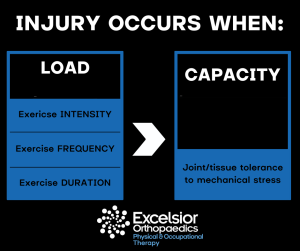
1.) Exercise Intensity – How Physically Demanding Is Your Workout?
For aerobic exercise, such as walking, running, or biking, one easy and valid way to measure intensity is with the rate of perceived exertion (RPE) scale. The RPE scale is a numeric tool, scaled from 0-10, that is a subjective measure of intensity based on how your body feels, fatigue levels, perspiration, etc. When beginning an exercise program, you want to aim for what indicates a moderate intensity: no more than a 4-6 out of 10.
For anaerobic exercise, such as strength training, intensity may be measured by the resistance level. Several studies suggest that when looking to build strength, you want to use weights that allow you to achieve a 6-12 rep range, which provides the best combo for load and volume. Loads lighter than this, such as being able to complete 12-15 repetitions of a particular weight, would be designed to increase endurance as opposed to strength.
2.) Exercise Frequency – How Often Are You Exercising?
How often you exercise will depend on several variables, including volume, intensity, nutrition, sleep, goals, etc. Studies have shown that for strength training, 2-3 alternating days per week is effective for beginners, whereas 1-2 days per week may be an effective rate for maintenance in more established exercisers. To best prevent injury or prolonged muscle soreness, you generally want 72 hours of recovery prior to revisiting a particular muscle group.
(3) Exercise Duration – How Long Are You Exercising For?
The duration of aerobic exercise will often directly tie in with the intensity, and because of this, there is no perfect guideline for how long an exercise session should last. American Heart Association guidelines suggest 150 minutes of moderate intensity aerobic activity per week. Divided by 7 days in a week, this is roughly 20 minutes of daily aerobic activity.
For resistance training, duration might refer to how many exercises you are completing in each workout. A recent systematic review of the effects of different resistance training on muscle growth concluded a standard recommendation of completing 12-20 sets per major muscle group per week. If you are engaging in a glute and quadriceps-focused strengthening program 2x/week, this would mean completing 6-10 total sets for each of those muscle groups in each workout.
When exercising, the goal is to avoid underdosing while also avoiding injury. Being mindful of these three variables should help you do just that.
Need more guidance? Learn more about physical therapy at Excelsior Orthopaedics here, and call (716) 250-6500.
Article authored by Jaden Gillette, PT, DPT

