
April is Occupational Therapy Month. Learn what an occupational therapist’s role is in YOUR rehabilitation!
In this article, we will discuss the role and responsibilities of the occupational therapist and how we serve as meaningful part of the orthopedic care team.
WHAT IS THE OCCUAPTIONAL THERAPISTS ROLE IN ORTHOPEDIC REHABILITATION?
- An occupational therapist helps patients recover/restore/regain function after injuries or conditions that impact their musculoskeletal system, as well as pre and post operative surgeries, usually of the upper extremities. Some common injuries and conditions that our occupational therapists treat include carpal tunnel syndrome, wrist/finger sprains or fractures, golfers/tennis elbow, shoulder diagnoses, and bicep/triceps strains or tears. A therapist works to improve mobility, strength, and overall functionality – aiming to help the patient return to their daily activities.
WHAT IS THE DIFFERENCE BETWEEN A PT AND OT?
- The main difference between a physical therapist (PT) and an occupational therapist (OT) in the orthopedic setting is that PTs are generally working on diagnoses from the spine as well as extremities, while OTs are mostly working with the upper extremities. In addition, PTs are primarily working on gross motor skills – strength, mobility, balance, coordination, motor control, etc. – and how these skills interact and contribute toward function. OTs focus more on overall function + fine/gross motor skills of the affected extremity and ability to complete daily necessary activities based on each patient. Depending on the patient, an OT and PT may collaborate or cross-treat a particular diagnosis. Both the OT’s and PT’s main goal is working toward increasing independence and helping their patient optimize function and performance with their daily activities.
WHAT TO EXPECT DURING YOUR EVALUATION
- After reviewing the referring doctors’ notes, the occupational therapist will discuss with the patient what their primary complaint and limitations are. Specifically, the primary focus of an evaluation is to determine the impact of the injury or condition on one’s ADLs, or “activities of daily living” – eating, dressing, bathing, hygiene. We will ask how your injury has impaired the patient’s ability to perform these functional tasks.
- After gaining subjective information, the therapist then evaluates the affected limb or body part by gaining objective information – range of motion, strength, etc. – and will perform any necessary diagnostic tests. Depending on the patient’s condition/diagnosis, the therapist may also provide education regarding wound care for post operative cases. Our occupational therapists ensure continuous education is provided throughout the evaluation as well as follow up treatment sessions regarding the patient’s diagnosis and progression.
- Concluding the evaluation, the therapist will use his or her clinical expertise and reasoning to determine appropriate exercises to begin with and will likely send you home with a home exercise program. We will also discuss an appropriate frequency for follow-up appointments based on your specific condition to ensure a tailored and effective rehabilitation plan that best supports your recovery.
WHAT TO EXPECT THROUGHOUT YOUR COURSE OF THERAPY
- Improving Strength/Endurance
- Occupational therapists will work to develop a personalized exercise program tailored to each patient’s specific needs. The programs include exercises and stretches prescribed to restore function in a progressive manner. Progressive exercises are clinically chosen to assist in building strength/endurance in weakened muscles that typically support injured or immobilized joints. Activities are graded (increased/decreased difficulty) based on established clinical protocols and the patient’s individual feedback to ensure optimal progress and safety throughout the rehabilitation process. Information regarding reducing injury when starting an exercise program can be found by clicking/tapping here.
- Increasing Range of Motion/stretching
- Occupational therapists use range of motion techniques and exercises to restore flexibility, improve movement, and reduce stiffness. Therapists combine a regimen of ROM exercises that enable patients to move their extremities through their full range of motion. For patients with limited movement, passive range of motion exercises are employed to help guide the extremity through the full range. Along with exercises, the therapist will perform hands-on therapy by passively moving the patient’s extremity through further range while also completing joint mobilizations to alleviate tightness, improve flexibility, and promote better tissue healing.
- Pre and post operative surgical rehabilitation
- An occupational therapist plays a crucial role in both pre and post operative rehabilitation by focusing on restoring function, promoting independence, and enhancing recovery outcomes. Pre-operatively, the therapist will help to improve range of motion (ROM) and strengthen the muscles surrounding the affected joint/injury to ensure the muscles are structurally sound, which will support the recovery process after surgery. Additionally, therapists educate the patient on what to expect after surgery and help them to make adaptations for activities of daily living as they recover. Prehabilitation programs help improve post-surgical outcomes by enhancing the patient’s ability to cope with recovery.
- In the post operative world, the therapist employs techniques to assist the patient in performing essential activities while ensuring they do not strain or injure their healing joints or muscles. The therapist will follow specific protocols for regaining strength and ROM that have been established by their surgical team and will tailor their therapy session and exercises to align with these guidelines.
Occupational therapists play a crucial role in the orthopedic care team – working towards increasing the patient’s ability return to their meaningful daily activities! Interested in working with our OTs to improve your function with daily activities? Schedule an appointment today with our rehab team – https://www.excelsiorortho.com/schedule-an-appointment/
HEAR & SEE IT FROM A PATIENT!
In this section, read the real testimonial of an Excelsior Orthopaedics patient who required occupational therapy. Please note: This testimonial has been edited for clarity and grammar.
“My story began on September 3, 2024. I was excited for my daughter to start her first day of sophomore year. I expected the traffic to be busier than usual. Rather than drive down the busy street in front of the school, I decided to turn on the next street. I never would have thought that decision would change my life forever. I also thought nothing of the oncoming SUV until it was too late. The other vehicle had slammed into the front driver side of my car causing the airbags to deploy.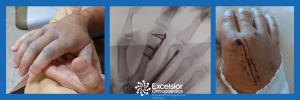
After the initial shock wore off, I realized that I could not move my hand. The X-ray taken at the hospital revealed that the air bag had broke my 2nd and 3rd metacarpal bones in my dominant right hand. At that point, I was told to go to Excelsior Orthopaedics for an evaluation from an orthopedic doctor. At Excelsior, I was informed my hand needed surgery to fix the broken bones. Two days later, I had surgery where Dr. Callahan had to use multiple permanent screws and braces to fix my broken bones. Surgery took double the estimated time due to how extensive the break was. Once surgery was complete, I had two weeks to wait before getting my cast off. These two weeks were the hardest due to the pain and issues I had sleeping. I was happy to finally get the cast off and stitches removed. It was that day that I was fitted for my removable cast and was able to start OT.
Beginning OT was very tough, and it involved stretching my very stiff joints and ligaments. My therapist, Morgan, did an awesome job stretching my fingers and wrist. She also showed me numerous exercises designed to help regain strength in my fingers and wrist. My favorite exercise was finding the beads in the putty. It didn’t start out as my favorite because it was very difficult, but overtime became easier. I was also given ASTYM treatment, which I felt helped relieve scar tissue in my hand. By the end of my therapy I would have almost 40 OT visits over six months. And while I still have pain and never regained the ability to make a full fist like before the accident, I did find OT to be very beneficial in regaining strength in my hand. Morgan and team were very instrumental in getting me back to my ‘new normal.'”
Article authored by Morgan Christ, OTR/L

